
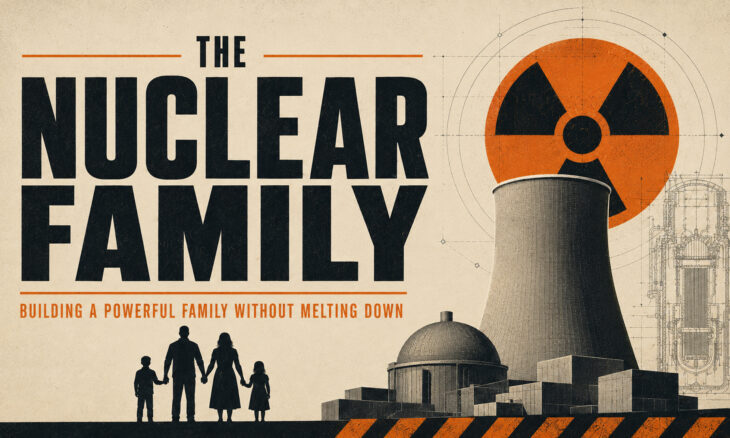
If you say the word nuclear and everybody’s head goes to the same place: the cloud, the siren, the drill under the school desk.
- But there are two entirely different ways to get power out of the center of an atom, and only one of them makes that cloud.
- Fissionsplits a heavy atom apart. Fusion presses two light ones together until they become one.
- Both release enormous energy. They are opposite operations with opposite costs, and almost nobody outside a physics class can tell you which is which.
What’s crazy is that most of us can’t tell which one is running in our own lives and homes. Both produce immediate motivation, but the long-term outcomes are vastly different!
FISSION — THE POWER OF DIVISION
Division is what humans do best.
- December 1942, under the stands of a football stadium in Chicago, a team led by Enrico Fermi split atoms on purpose for the first time.
- Every commercial power plant on this planet still runs on that same trick.
Splitting things is easy. It’s the operation humans figured out first, and it’s the only one we’ve ever gotten to work at scale.
And it does release energy – lots of it by comparison.
- But fission leaves waste that contaminates the environment for generations
- Cesium-137 has a half-life. (Meaning it takes about thirty years to lose half its danger)
- Roughly one generation
FUSION — THE POWER OF UNITY
And it’s harder in every possible way.
It takes heat and pressure most of us can’t imagine, sustained over time, with nothing allowed to leak.
Two separate things pressed together until they stop being two things.
Fusion releases far more energy than fission ever could
- 4 times as much.
- It leaves no long-lived waste behind.
- And it cannot melt down — if the containment fails, the reaction doesn’t explode. It just stops.
All of the stars function on fusion reactions,
- But the thing that they have that we don’t is a powerful force that brings the real heat and energy needed to sustain the reaction.
- That’s the God component of this whole equation that we will explore as we move through this series together.
When God introduces marriage, he describes a fusion reaction: Genesis 2:24 — the two shall become one flesh.
Every power plant human beings have ever built runs on splitting things apart. Every star in the sky runs on bringing things together.
Earth runs on fission. Heaven runs on fusion. And you get to pick which one is going in your living room.
Matthew 19:6 — what God has joined together, let no one separate.
- Separated. Jesus put both operations in one sentence.
- The verb behind joined togetheris a yoking word — two animals bound to one beam, pulling as one thing because the beam gives them no other option.
Jesus is telling us what kind of reaction a marriage is designed to be, and warning us that division is always available.
He has every right to ask us to do the near-impossible because He did the joining first. He is the one who bound Himself to a bride who had every reason to be split off, and refused to separate.
Sermon Intro:
We live in a world full of contracts:
I have signed my name to more paper than I can remember
- A note at the bank on a car
- A contract outlining the purchase of a business
- A stack at a couple of closing tables so thick the ladies had to flip the pages for me.
- And a bunch of smaller agreements for cards and in-store purchases.
Every one of those documents had a clause: here’s what happens if you stop paying.
It’s the reason the document exists. Two people who trust each other completely don’t need a contract.
My grandfather often lamented that we no longer live in a world where a man’s word or a handshake meant anything. For a lot of us, that’s an almost incomprehensible sentimental statement.
A contract is what you write when you both want the terms to be understood and undeniable.
Which brings us to the one day in many of our lives when we stood up in front of everybody we knew, in our good clothes, and said words out loud instead of signing them. We answered affirmative “I Do” statements to what sounds like a verbal contract, but it’s actually quite different.
What exactly did we do that day?
- Who else was standing up there when you made that promise?
- What holds a marriage together on a day when neither person wants to hold it?
A promise you can’t get out of is the one foundation strong enough to build on.
We are the most contracted people who have ever lived. Terms of service nobody reads.
- A warranty on a refrigerator.
- An agreement with the phone company longer than the book of Romans,
- We scroll to the bottom and tap
And it has trained us to believe something about every relationship we’ve got: as long as I hold up my end, I’ve done enough.
That is the most reasonable thing in the world.
It is also not how God has ever once related to a human being.
I. The Core
The first question we must explore today is this: Do God-shaped relationships run on terms, or on something deeper? Is it a contract or covenant?
The Greeks had a perfectly good word for a negotiated agreement between two equal parties: synthēkē.
- Terms,
- consideration,
- both sides at the table.
But when Jewish translators rendered Hebrew berith the Biblical word for covenant into Greek, they did not use it.
- They reached instead for diathēkē— the word for a will.
- A last will and testament.
That’s because a contract is negotiated between parties.
A will is enacted by one party and received by the other.
- You typically don’t negotiate the terms of a will you were named in. You found out what somebody decided about you.
Every time scripture speaks of a covenant, that’s the word underneath it. - It’s not a deal you struck with God.
- It’s a provision God made and then told you about.
Here’s how you find out whether you’re in a covenant or a contract.
A contract has a termination clause.
- The failure of one party releases the other.
- That’s not a flaw in contracts. That’s the service they provide.
A covenant is a love that stays when the terms have been broken, because the terms were never what held it up.
- The Hebrew word for covenant loyalty, and Scripture’s favorite thing to say about God, is translated as steadfast love, lovingkindness, mercy.(Although none of these are really sufficient) is loyalty that survives the other person’s failure to earn it.
Which means a covenant is not a better contract. It is a different kind of thing entirely, and it does its finest work precisely where a contract would rightly walk away.
It’s important to consider that covenants were the defining feature of powerful relationships all throughout the Old Testament.
1 Samuel 18:1–4. Jonathan and David swore a covenant.
Jonathan hands over his robe, armor, sword, bow, and belt.
Understand what he’s doing. Jonathan is the crown prince.
- That robe is the throne.
- He’s giving away his own succession to the man who’s going to take it.
And there is nothing coming back.
- David has no throne,
- no army,
- no name,
- nothing to return.
That’s the structure every time:
- Somebody invests before there’s any return,
- and that investment is what creates the relationship— it isn’t the reward for one.
That is not Jonathan being unusually generous. That’s Jonathan doing, on a small scale, what God has done on the largest one.
God was the first investor
Romans 5:8 — God demonstrates His love in this: while we were still sinners, Christ died for us. Before. Not after we came around. Not when the terms improved.
Luke 22:20 — He lifts the cup the night before He dies and calls it the new covenant in my blood. He says it before the cross, to a table of men who are hours from abandoning Him. He knew the terms would be broken and He enacted it anyway.
God did not offer us a deal. God made a will, signed it in His own blood, named us in it, and then invited us to invest alongside Him.
And you cannot invest in something you’re still negotiating. The negotiating is over. That’s what finished meant.
This is precisely what the church is made of:
Ephesians 2:12 -13
Remember that you were at that time separated from Christ, alienated from the commonwealth of Israel and strangers to the covenants of promise, having no hope and without God in the world. 13 But now in Christ Jesus you who once were far off have been brought near by the blood of Christ.
Notice what brought you near. Christ’s blood…
2:14–16
For he himself is our peace, who has made us both one and has broken down in his flesh the dividing wall of hostility15 by abolishing the law of commandments expressed in ordinances, that he might create in himself one new man in place of the two, so making peace, 16 and might reconcile us both to God in one body through the cross, thereby killing the hostility.
So the unity of this church is not a contract of mutual pleasantness where I’m decent to you as long as you’re decent to me. It is a vertical covenant producing a horizontal one.
- And it means every relationship in Christ runs on the same fuel a marriage does.
- If the only thing holding relationships together is that they’ve been holding up their end, you have a contract with them
- Contracts terminate, which creates the divisive world we live in today!
Marriage, church, friendship, parenting: God-shaped relationships all run on the same thing, and it is never terms.
- A contract asks Have I done enough?— and the beauty of that question is you can actually answer it.
- A covenant asks, am I still all in?— and that question has no permanent answer. You just wake up and answer it again.
- A contract can be satisfied. A covenant can only be continued.
Everything we’re about to say about coming apart and coming together assumes you’ve settled which one you’re in.
II. THE FORGOTTEN WITNESS
Malachi 2:13–16
And this second thing you do. You cover the Lord‘s altar with tears, with weeping and groaning because he no longer regards the offering or accepts it with favor from your hand. 14 But you say, “Why does he not?” Because the Lord was witness between you and the wife of your youth, to whom you have been faithless, though she is your companion and your wife by covenant. 15 Did he not make them one, with a portion of the Spirit in their union?
Picture the scene Malachi is describing:
- The altar is crowded,
- the worship is loud,
- men are weeping over sacrifices God will not touch. They want to know why. Why won’t He take it?
“The LORD has been witness between you and the wife of your youth.” There were three parties standing at your wedding.
There are two words here that are important to consider.
‘ed — a witness in that world was never a spectator.
- A witness was the one who held the terms and showed up when they broke.
- You didn’t invite a witness for the photographs.
- You invited one because someday somebody might change their mind.
chaberet — companion, partner, one bound alongside you.
- It’s used here in Malachi and nowhere else in Scripture.
- He reached for a word so rare because wifewas not carrying the weight he needed.
There is a troubling story that unfolds in Hosea 3
- God tells His prophet to go redeem a woman whom he had already redeemed and married, and who has left him for a life of slavery again!
- Hosea pays fifteen shekels of silver and a load of barley to get her back.
- The text doesn’t tell us who he’s paying It only tells us the price.
Picture this a man counting out silver for a wife that chose slavery and prostitution over him……
- There is no version of that event that isn’t humiliating.
That’s God’s own testimony about Himself,
- Dramatized in a man’s actual marriage.
- The God who shows up as a witness against unfaithful husbands is the same God who takes on the role of husband to an unfaithful people.
And in Luke 22:20 He lifts a cup and calls it the new covenant in His blood, with the people who are about to break faith with Him sitting right there eating.
VS 15
Did he not make them one, with a portion of the Spirit in their union?
- Jeremiah 3:8— God says He sent Israel away with a decree of divorce. It’s there. The paperwork gets filed in the prophetic drama.
- And then Isaiah 50:1— God asks: where is your mother’s certificate of divorce? The question expects no document to be produced.
- Two prophets, two pictures, The severance is real, and it is not final.
- Isaiah 54:7–8— for a brief moment I abandoned you, but with great compassion I will gather you.
God was a witness at your wedding. Take that as pressure if you need pressure today; some of us do.
But take it the other way if you can, the Witness standing there has done this before.
- He’s been the faithful party to an unfaithful spouse.
- He’s counted out the silver.
- He knows exactly what it costs to stay when staying isn’t deserved.
Revelation 19:7 — and it ends with a wedding. The marriage of the Lamb has come, and his bride has made herself ready.
- She got ready. After everything. That’s the whole hope of the thing
- He’s not asking you to be more faithful than He’s been. He’s asking you to be faithful the way He already was.
III. GLUE
What’s at the core of a marriage that holds? A covenant somebody else kept first, and a grip that outlasts our reasons for holding on.
Genesis 2:24
“Therefore a man shall leave his father and his mother and hold fast to his wife, and they shall become one flesh”
A: It’s the verb we skip
We preach the first and third ones at a lot of weddings. But we treat the middle one like a transition. It’s way more than that!
- Cling – dabaq– stick fast, be glued to
- It’s not a feeling word. You can do it on a day you feel nothing, which is exactly why God picked it.
B · The clamp
Anybody who’s glued two boards together knows the glue isn’t what holds them at first.
- You run the bead of glue,
- you press them together,
- and then you leave them clamped
The clamps are not permanent, but the bond needs the two pieces held still long enough to become one piece.
Take the clamp off in twenty minutes and you don’t have a joint. You have two boards with glue on them.
Most of what we call marriage problems are clamp problems.
Something was true and good and it just never got held still long enough to set.
And here’s the other thing every woodworker knows: when a good joint finally does fail, it doesn’t split at the seam. The wood tears. The bond outlasts the material.
C · Ruth on the road
Ruth 1:14 — Orpah kisses her mother-in-law and goes home. Ruth clung to her. Same verb.
Stand with me on that road a second.
- Two widows and an old woman with nothing.
- No obligation.
- No benefit.
- No husband left to keep anybody anywhere.
And Scripture doesn’t say one word against Orpah — she did the reasonable thing.
Ruth clings where there’s no contract to enforce and no return to expect. That’s the whole demonstration. Clinging is what’s left when every other reason to stay is gone.
And it’s the same verb Deuteronomy uses for how Israel holds onto God.
The way you hold your spouse and the way you hold God are described with the same word — which means a cold season in your marriage and a dry season in your faith are not two separate problems.
Takeaways from the Core:
Not romance. Proximity, repeated. Here’s what I mean, and it’s more ordinary than you want it to be.
1. Stay in the room.The single most practical thing in this outline. When it gets hard, most of us leave the garage, the phone, the deer stand, a second job. That’s fine for a moment, but remember sometimes clinging is refusing to exit the room, even when you have nothing good to say in it.
2. Build the clamps.Something that holds you two still on a regular schedule whether you feel like it or not. A standing meal. Friday night, same time. Church event together instead of separately. The clamp is not the marriage. The clamp is what holds you steady while the marriage sets.
3. Say this unglamorous sentence.I’m not going anywhere. Most spouses have not heard it in years, and a good number of them are quietly wondering.
4. Cut the private exits.The escape fund nobody knows about. The friend who only ever takes your side. The name you scroll past but never delete. Every private exit is a clamp loosened.
I’ve sat with couples in the worst week of their marriage, and what I remember isn’t anything anybody said. It’s which ones were sitting in the same car in the parking lot afterward.
He clung first. Ephesians 5:31–32 — Paul quotes Genesis 2:24 and then says the quiet part: this mystery is profound — I’m talking about Christ and the church.
Watch Him use all three verbs.
- He left— heaven, Philippians
- He clung— to a bride who was actively walking away.
- He became one flesh— we’re called members of His body.
Glue has no exit clause written into it. It has a failure point, and that’s a different kind of thing entirely — a clause is a plan, a failure point is a tragedy.
Conclusion:
There were three of you up there. There have only ever been two of you thinking about leaving.
Our World says: stay as long as it’s working.
But Jesus says: staying might be the thing that makes it work.
World says: protect yourself — keep an exit, keep a fund, keep a friend who takes your side.
Jesus says: lay your life down first, before others have earned it.
World says: marriage is supposed to make you happy.
Jesus says: marriage will make you holy, and holy people turn out to be the genuinely happy ones.
WHAT TO DO WITH THIS WEEK
- Find the clause.Everybody’s got one — the condition you’ve never said out loud that you believe would end this. Name it to yourself this week. That’s all. Naming it is the whole assignment.
- Quit keeping the ledger.If you can tell me your score right now, you’re running a contract. Contracts require accounting. Covenants don’t. I Cor 13 – “Keeps no record of wrongs”
- Remember the covenant God has made with you. This is the very reason Jesus established the observance of the Lord’s Supper. He said, “As often as you do this, do this in remembrance of me.” That remembrance reminds us of the great sacrifice offered for our salvation. It also reminds us of our obligation to others.